






The other day I made a note in my book review spreadsheet to the effect that if I had read that book aged (say) ten, I would have been doomed with a very particular doom—I would have made it my entire personality for years, thereby crowding out opportunities for other art to get a toehold in there. I had a similar feeling upon reading Peter Beagle’s The Last Unicorn for the first time in my early 20s—a sense that a bullet had been dodged. Not the book itself, I mean, just that we must take care to allow the developing mind—especially one as squishy and impressionable as mine—to receive varying influences, not just one.
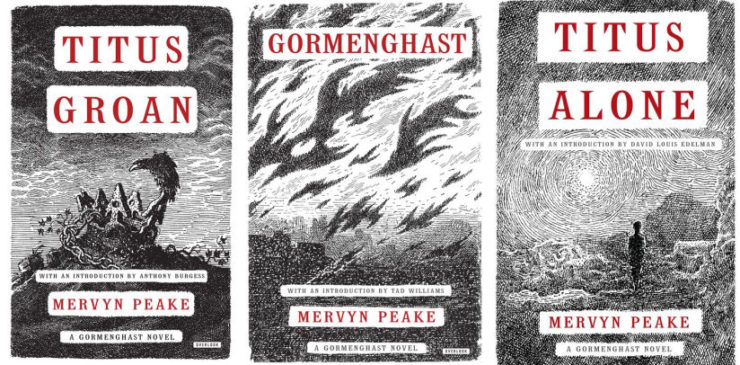
Anyway, I first read Mervyn Peake’s Gormenghast books when I was seventeen, and thank goodness for that. Because it was bad enough at that age—when I could dig my heels against being utterly possessed. If I had discovered it any earlier, there would have been no saving me.
I’m struggling now, almost thirty years later, to think of any book or series that has had the same effect on me. I own the trilogy individually in hard copy and ebook (plus the fourth book, written by Peake’s wife, which I haven’t read), a paperback omnibus, and the fancy slipcased Folio version that’s so massive it’s bending the particleboard shelf it rests on. I keep thinking that my fanboi level is a little weird—you hardly ever hear people mention it—and yet not, because the first book was published in 1946 and it’s never been out of print; it’s massively popular and… invisible at the same time?
What’s it about, you might be asking, if you haven’t read it yet? It’s, uh… well it’s tricky. See, there’s this place, Gormenghast Castle (near Gormenghast Mountain, next to Gormenghast River), and it’s… it’s very old, it’s occupied by a bunch of Certifiable Weirdies, and when our story opens, a kitchen boy named Steerpike is scheming to take over its governance, and the ruling family (the Groans) have just produced a new heir, Titus the 77th Earl of Gormenghast. There you go, there’s the plot.
If I were looking for comps, I’d point to the long tradition of ‘weird city’ books, because above all Gormenghast is about place. There’s Adrian Tchaikovsky’s Tyrant Philosophers series, China Mieville’s Bas-Lag books, Jeff VanderMeer’s Ambergris series, Alex Pheby’s Cities of the Weft books… the cities are weird. The villains are villainous. But to me, they’re still apples and oranges to the Gormenghast books—they’re trying to do something else.
For me, the great appeal of Gormenghast has nothing to do with what happens in it. It’s all about those great intangibles that you cannot quite put your finger on—the imagery, the sensory detail, the prose, the individual scenes that have this theatrical quality of a play within a play and are connected to preceding and succeeding events with only the most tenuous cause and effect.
All three books feel less like novels in their own right than a series of impossibly glittering, barely sequential set-pieces, nearly static even when the participants are in frenetic motion. Some go on for pages—Flay and Swelter’s fight to the death in the cobwebbed rafters; Titus’ tenth birthday celebration—and some are a horror novel’s condensed into a sentence fragment (“…when, climbing demented into the Tower of Flints, the Earl gave himself up to the hunger of the owls”). Exaggerated attention and tenderness is lavished on things that seem utterly inconsequential—how can you justify multiple pages on a schoolboy’s feverish musings about a blue marble or yellow light?—and essential details are sketched in precisely where the reader might want to understand something crucial.
These days when I re-read the books, I find myself thinking: Ooh, a modern editor would cut that. Would cut that and that… would never allow that whole chapter. Would demand a character arc. Roundedness, complexity. Could everyone stop being so camp, could the villains stop being so cartoonishly evil, could people be more consistent, could relationships incorporate some subtlety, could the pacing—and then I stop myself. Do I think this is a series that could get published now? No, not really. Do I care? No. It makes me cling all the tighter to it, it helps me see what is precious to me that I rarely see in modern writing.
Here’s the thing, I think, that these books gave me—or infected me with—so long ago. And that is the idea of being unapologetic about your art. Not just deliberate with it, not just self-indulgent to the point of stubbornness, not just—allow me to present an entire chapter describing a heronry, you know the one—intensely obsessed with the presentation, but also not apologizing about it or walking it back.
Where does this weirdly isolated place get things like chocolate or lemons or lamp-oil? Peake doesn’t care. Is the Creature really magic? Not important. How are people’s offspring dealing with the genetic bottleneck of a completely closed system, how do we have children all of an age in Titus’ class?
At this point I picture Peake getting really exasperated. You’re missing the point, I imagine him saying, and I melt with relief and validation. You’re missing the point. We cannot, absolutely cannot, expect every work of genre to be the plot-driven adventure story with world-shattering stakes that swamp modern shelves. If anything, we cannot expect the author to even be doing all the work of connecting the causality that we refer to as plot. Maybe shit just does happen sometimes. Maybe things are just beautiful and meaningless, or beautiful and meaningful, and we the reader can either sit with that and take it in and allow ourselves to feel joy at beauty, or we can put the book down and go read something where the stakes are spoonfed to us on page two, just like Save the Cat tells us.
What I took from Gormenghast was that my love for it was acceptable—it was understandable, to Peake if no one else. I was allowed to love it, and I was allowed to love how it had been done, and I was invited to join Peake in never saying “Oh, sorry I didn’t explain that.” I was allowed to write books like that. After all, it had happened before; as in law, I could argue precedent.
I never explain how the extradimensional beings appear in These Lifeless Things. I never confirm whether the children in need of rescue are real or hallucinated bait; that’s the point. I don’t tell the characters or the reader in And What Can We Offer You Tonight how Winfield comes back from the dead. That’s on purpose. I don’t want you to know and I’m not saying sorry for it and I’m not telling you. You are focusing on the wrong things: that’s the message.
I suppose after this whole long lovesong it’s weird that my Gormenghast Stuff collection includes a VHS of the BBC adaptation, starring Jonathan Rhys-Meyers as Steerpike, and I’ve never seen it. For one thing, I don’t have a VCR; but that’s easy enough to fix. The fact is, there are books for which no adaptation will have an iota of interest to me, and the Gormenghast books are on that list.
An adaptation to visual media will capture exactly that—the visuals—and not what I treasure about the book, which is the writing itself. I’m not interested in the sequential story, the why and the who and the how. I am interested in this baroque description of a young girl’s outfit:
“Her crimson dress inflames grey corridors, or flaring in a sunshaft through high branches makes of the deep green shadows a greenness darker yet, and a darkness greener.”
Is this the work of a plot-driven novel? Wrong question, entirely the wrong question. We are also wrong to ask whether poetry needs a plot. Both only need movement, and that need not be linear. It can also be into the shadows, where, in the darkness, we may find ourselves not to be alone.

I also have three copies of the novels including the Folio Society doorstop. When other people were swooning over Frodo, I was relishing Gormenghast, my spiritual home. This may just be the best piece on the novels I’ve ever read.
BTW, TITUS AWAKES isn’t worth it, sadly—Maeve just wasn’t a writer. Don’t bother with the 2000 BBC version, either. It’s star-studded and and DOA.
Oo, Gormenghast. I read it as a young teen – my mother’s paperback copies are from 1973 – and it left me firmly confused and very frustrated. Even now, thinking about it, I feel the same way. I was unable to finish the BBC production because some things are unfilmable…
I made the strategic error of finishing Swann’s Way by Proust and following it up by next reading Titus Groan. About halfway in, I realized I was still reading Proust …
OK, now you’ve made me want to read Proust…
I agree with the others, don’t watch the BBC production. I am careful about not watching adaptations of stories that worked uniquely well as books (never seen ‘The Time Traveler’s Wife’, for instance). I did, however, take a chance on ‘Jonathan Strange and Mr. Norrell’ and was pleasantly surprised. So you never know…
The novelist who most resembles the ‘don’t force me into your adventure mold’ mindset is Neal Stephenson. Yes, there’s a plot, but Neal goes off on wonderful digressions about things that don’t really matter in the story, and they’re wonderful and fascinating so you don’t mind he’s padding out a 900 page book with them. The chapter on pulling a wisdom tooth in ‘Cryptonomicon’ is an example.
I learned about the series by turning on PBS in the middle of the night in my teens. I miss that kind of experience.
And Peake’s illustrations are perfect. Like the writing: just detailed enough, just vague enough to convey everything he wants to.
The only thing that remains with me of the BBC production is the opening song, which is haunting — https://youtu.be/NnKMxSHAM5s
A painterly writer. The “boy in Darkness” collection of shorts is equally absorbing.
When I read this trilogy, I believe it was in the mid 70’s, and I was in my mid 20’s. It was really hard to get a handle on. At times I would be tempted to put it aside, unable to say why the heck I was reading it. And yet, it was impossible to put down. I was reading it out of order, as I read Gormenghast first. I was happy to have finished, and I can’t say I found myself either inspired or educated by then. Still, I was glad of the experience. It felt like a book written by the love-child of Dickens, Poe, and Timothy Leary. I’ve never gotten up the desire to re-read it, yet I’m glad for experiencing the language and poetry of it.
Yes, no one seems to understand My love for Gormanghast. Thanks so much for the article, I felt like you summed up well in the last paragraph, but I wish there was more exploration into the theme of poetry in motion without story.
What are you thoughts on th BBC adaptation?
My usual method of describing Gormenghast to people is to say “it’s as if Dickens had been on crack and written fantasy.” (Which, to be clear, I mean as in a positive sense!)
I loved the adaptation…but I’ve never got around to reading the book. I think the adaptation got the feeling of idiosyncratic weirdness tied to this impossible and mad, yet inexplicably alive and characterful place right, but while it tries via visuals I don’t think you can match prose like you’ve described here. Still, I think it was creative and weird in a way that really stuck a burr in my brain that never quite left. I should read the books though.
It’s worth a watch at least, even if it won’t move you to the point you make it your identity.
Maybe I didn’t discover Gormenghast in time. I read Titus Groan in my 40s and didn’t enjoy it at all.
I absolutely love These Lifeless Things however, so clearly it’s not that I have bad taste, I probably just missed the point.
I’ll have to give Gormenghast another go one of these days.
When I read Piranesi, my first thought was, “Ah, Clarke has read Gormenghast.”